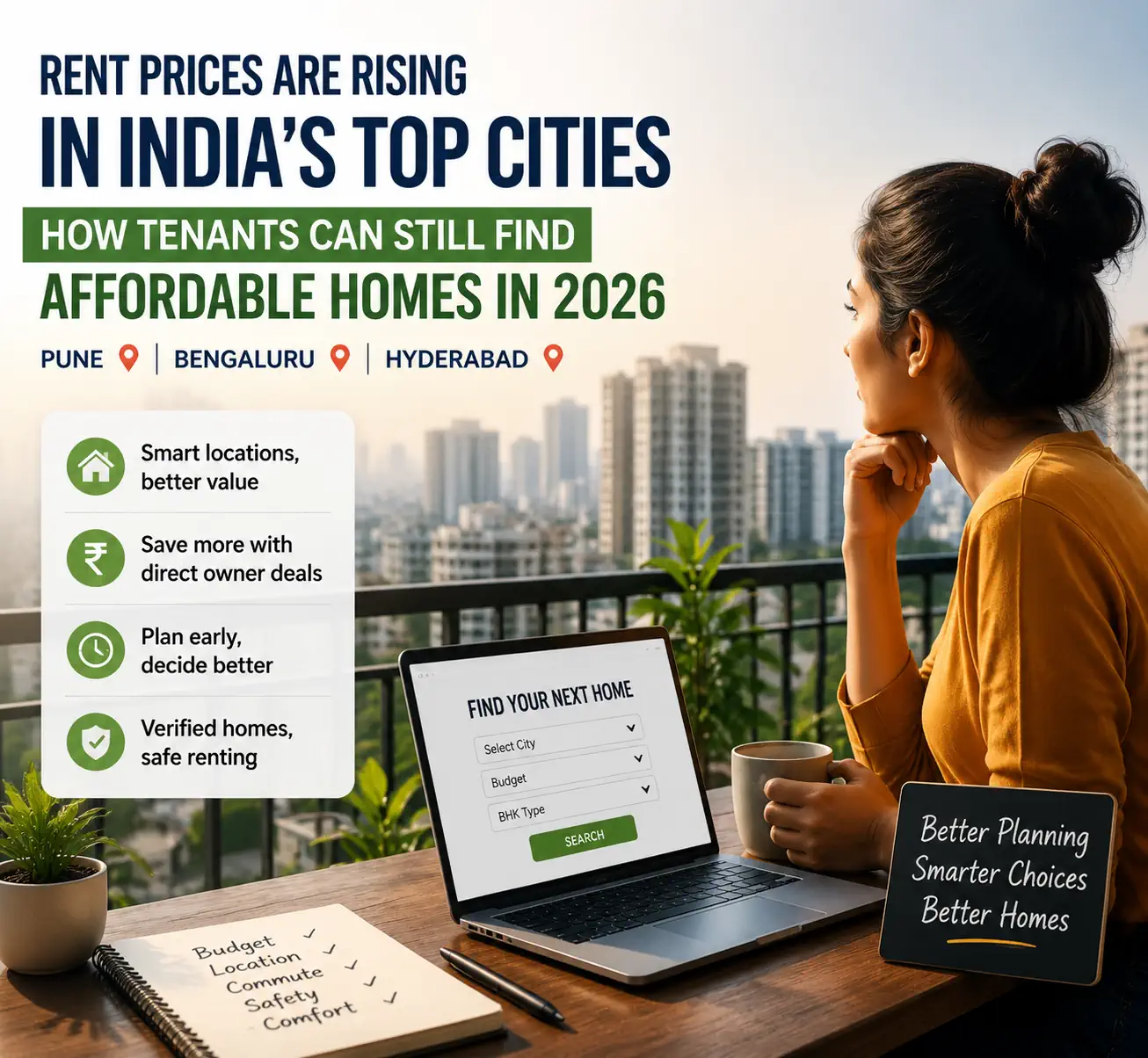
Renting a home in India’s major cities has become noticeably more expensive in recent years, and 2026 is no exception. For many young professionals moving to cities like Pune, Bengaluru, and Hyderabad, the first shock is often not the job market or relocation stress, it is the rent itself. A simple 1BHK or shared apartment now takes up a much larger share of monthly income than it did just a few years ago.
What has changed is not only pricing, but pressure. Demand for well-located, safe, and well-maintained homes has grown sharply, while supply in the most preferred neighborhoods has not kept pace. As a result, tenants are competing for fewer “acceptable” homes, which naturally pushes prices upward in key pockets of major cities.
In cities like Pune, Bengaluru, and Hyderabad, this pattern is especially visible around employment hubs. Areas close to IT corridors, metro lines, and established residential societies continue to see steady rent increases, while more affordable options are gradually shifting toward emerging residential zones on the outskirts.
The real issue is not just rent - it is how people search
Most tenants begin their house hunt with a narrow focus: a fixed budget and a few well-known localities. This approach often leads to frustration because it ignores how dynamic city housing markets have become. The better strategy today is not to chase the cheapest listing in a popular area, but to understand connectivity, commute time, and emerging neighborhoods that offer better value for money.
Many tenants also underestimate how much inefficiency exists in the search process itself. Outdated listings, delayed responses, and multiple layers of communication often lead to rushed decisions. In many cases, people end up paying more simply because they are short on time or options at the final stage of their search.
One experienced property advisor often puts it simply: “The best rental deal is rarely the first one you see - it is usually the one you have time to compare properly.”
This reflects a shift in mindset that many renters are slowly adopting, moving from urgency-driven decisions to planned, informed choices.
Where tenants actually find better value today
Across major cities, a clear pattern is emerging. Slightly shifting away from high-demand central pockets often opens up better housing options without significantly affecting daily life. In Bengaluru, for example, a shortchange in location can mean better space and lower rent while still maintaining reasonable commute times. Similar trends can be observed in Pune and Hyderabad, where newer residential clusters are developing with improved infrastructure and relatively balanced pricing.
This is also where rental efficiency becomes important. Direct interaction with property owners, clearer availability, and faster decision cycles often reduce both cost and confusion. Tenants are increasingly realizing that the way they access listings matters almost as much as the listings themselves.
- Exploring emerging neighborhoods instead of only established hotspots
- Prioritizing commute and connectivity over locality reputation
- Starting the search early rather than under last-minute pressure
- Comparing multiple verified options before finalizing
These small shifts in behavior often lead to significantly better rental outcomes, even in a rising market.
In the end, the Indian rental landscape is not becoming unmanageable, it is simply becoming more selective. The homes are there, but they are no longer found through rushed decisions or limited search patterns. Tenants who adapt to this reality are still able to find homes that are both affordable and comfortable, even in rapidly growing urban centers.
The challenge in 2026 is not the absence of options. It is the ability to see them clearly before urgency narrows the view.